Wednesday, April 17, 2013

Day Eight: Case of the day


Prof Shires has been following a 19 year old girl who had what had been called secondary amenorrhea because she had some spotting for 4 months, but on further history she reported never using more than 1-2 pads/day. Hormonal evaluation revealed elevated serum gonodotropin levels, normal prolactin, and low estradiol and IGF-1.  However, her breast development was consistent with Tanner IV/V and her pelvic US reported visualization of a normal size uterus, without a thickened endometrium and normal ovaries.  

We saw her during our endocrine clinic last week and hypothesized about the possibility of Turner mosaicism.  Her karyotype returned 4 days later confirming this.


Tuesday, April 16, 2013

Day Seven: meeting the surgeons, pregnancy clinic, Journal Club

The Center for diabetes, one of the private clinics we drive by each day.

Today was an early morning, as Dr. Mandel gave a lecture to the surgery department on the "Management of Differentiated Thyroid Cancer." She discussed the importance of the pre-op US in the detection of LN disease, focused on detecting "clinically relevant" LN disease, and the importance of post-operative surveillance US. She also discussed the key role of surgery in the initial management of thyroid cancer and in the treatment of locoregional recurrence

Management of differentiated thyroid cancer 

After Dr. Mandel's lecture, we attended Dr. Huddle's pregnancy clinic. Our patient with the pheochromocytoma from last week came back to clinic today to be admitted. Her blood pressures were still well controlled and the plan for admission will be to wait until week 33 or 34 to deliver, unless her clinical condition deteriorates.

Ilona and Dr. Shires walking to the doc's cafe for lunch
Kershlin and one of the registrars at lunch.

Our barista and Dr. Mandel


We then headed to Journal Club at Wits. We review two JAMA papers on thyroid disease; one on "Subclinical hypothyroidism and CHD events and mortality" and the other on the "Association between BRAF V600E mutation and mortality in patients with papillary thyroid cancer."

Reviewing the papers one last time before JC.

studying hard and enjoying the lovely weather.


Monday, April 15, 2013

Day Six: Soweto and thyroid US

This morning we took a tour of Soweto.


 We started off at the Regina Mundi (Queen of the World) Church, which was an important gathering place for the people of Soweto, especially in the years during and after apartheid. On the day of the Soweto uprising, (June 16, 1976) people estimate that about 6,000 people fled to the church.

Regina Mundi church
Inside of the church
A sample election ballot
We then took a city bus into one of the poorer areas of Soweto, where government RDP (Reconstruction and Development Program) houses stand side-by-side shanty homes. The RDP homes are small but have electricity and running water inside and outside the house. The shanty homes are made mostly of corrugated metal and other supplies like cardboard or sheets of plastic. They have no electricity or running water, although the government has recently installed modern latrines near the shanty homes. Many of the people living in the shanties have come from the remote townships looking for work. Unemployment is quite high in Johannesburg, some official figures state it is almost 40%. However, many people in Soweto have unofficial businesses - selling fruit, alcohol, opening up barber shops, or beauty salons.

We met one of the women who lives in a shanty home. She is a 26 year old who came from the Eastern Cape with her seven year old son to join her husband, who was looking for work in Joburg. She has been living here for the past six months. She has no running water and uses the outside water from the neighbors who live in the RDP houses. The water is currently free, but the government is going to start put meters up and charging for excess usage, so this situation is likely to change.

Shanty houses

New latrines outside the shanty houses
Inside a shanty home
I have always felt that it is important to understand where patients live and the "social context" of their disease. I often went on home visits to patients starting in medical school. Seeing people's living situation and learning about what their jobs (or lack of employment) entail, demands of daily life, and stresses can put things such as med non-adherence, no-showing for clinic, failure to follow up for recommended testing in context. Although simple knowledge of these things does not change the situation, it can be a starting point to understand how important a patient's disease (especially an asymptomatic, chronic disease) is in his or her daily life and can allow you work out a treatment plan that is easier for patients to follow through with.

Names of the students killed during the Soweto Riots in 1976.
Our next stop was the Hector Pieterson museum, named for one of the young boys killed during the Soweto Uprising. After learning about the student riots, we walked down Vilakazi street to see Nelson Mandela's former home and Desmond Tutu's home. Two Nobel Peace Prize winners living on the same block....

Dr. Mandel and I outside of Nelson Mandela's home.
This area of Soweto is much more prosperous. We took a Kombi van (the major transportation system in the city) back to Bara (our fourth form of transportation for the day: car, bus, walking, Kombi!)

Practicing the Kombi hand sign for Bara -
looking at this photo, I'm not sure exactly where I would have ended up!
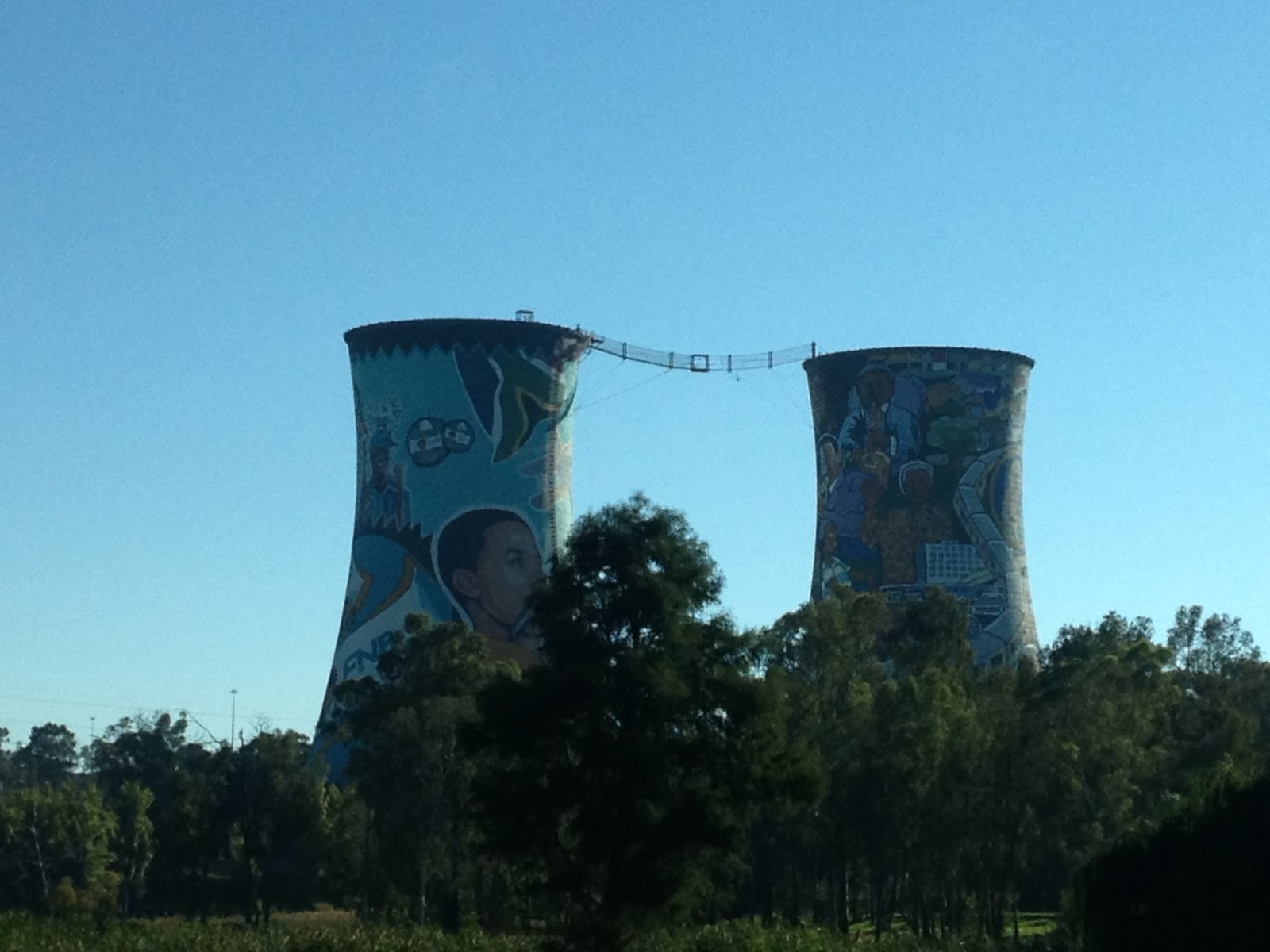
A Kombi driving by the Soweto towers. 

In the afternoon, Dr. Mandel spoke to the radiology and endocrine division about the US evaluation of the thyroid nodule. Eight patients from the endocrine and surgical clinics were evaluated during the session. We discussed their clinical cases and Dr. Mandel pointed out the salient imaging features. We evaluated several patients with thyroid nodules, a pre-op patient with medullary thyroid cancer and extensive lateral LN disease, a patient with Bx proven anaplastic carcinoma, correlated two sestimibi scans with US for patients with primary hyperparathyroidism, correlated a RAI uptake scan with US for a patient with hyperthyroidism, evaluated a post-operative neck US for residual LN in a patient with PTC.


correlating US with RAI uptake scan


On the way home we dropped by the African craft market in Rosebank, where we perused for bargains.

trying to find a good deal
TIA


Sunday, April 14, 2013

Weekend exploration

This weekend, Dr. Mandel and I wanted to explore Joburg a little more. On Saturday morning, we took a walking tour of downtown Joburg.  We started off in Maboneng Precinct, a newly revitalized area of the city. The main street has new hotels and hostels, restaurants and bars, trendy clothing boutiques, and a very popular weekly market on Sundays. Many of the people trying to revitalize the area are artists and there are wonderful murals and mosaics throughout the precinct (reminding me of Philadelphia’s urban mural project intended to engage people in the community through art that reflects the unique culture of the area made by the people in the area).

After seeing some of the modern renovations of Main Street we went to the Mai Mai market, seeing the juxtaposition of the modern and traditional Joburg. The site was first used as a stable to accommodate horses which were used to pull soil carts back in the 1940s. It was subsequently converted into a market and became an entry point for newly arrived migrants, under the custodianship of the old Johannesburg city council. It is the oldest market dedicated to traditional healing. Many of the shops sell traditional medicine (muti), masks and furs used during traditional ceremonies, and yet others cater to tourists.


Visiting traditional African healers is very common in SA. An estimated 60-80% of people consult with healers, often in conjunction with Western medicine. As we walked through the streets of the Mai Mai market, we noted several shops with herbs being left outside to dry.


After leaving the market place we walked to the Carlton center, a large shopping mall, and passed several shops and murals along the way.

Obviously I am not in the fashion...


Mural about the history of Joburg- from the gold rush to apartheid days and the modern city.


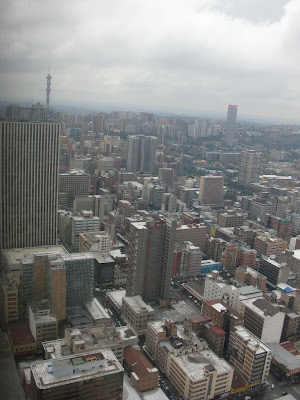
View of the city from the Carlton center.

After getting panoramic view from the top of the Carlton center, we visited the worker's museum and learned about the living and working conditions of the people (mostly Africans and Chinese) who worked in the gold mines in the early days of Joburg. These mines are the reason for the city - Joburg is the largest city that was not built surrounding a body of water. We finished the day at the Africa Museum in Newtown, learning a little bit more about the history of the city.


 Thanks to our guides Bheki and John for a wonderful time! If you are ever in the area, be sure to look them up.


After our tour ended, we went to constitutional hill, the site of the Old Fort Prison, where many political prisoners (including Gandhi, in 1908) were incarcerated alongside petty criminals and violent offenders.  The site is now the seat of the new Constitutional Court of South Africa.


On Saturday night, I went to see Johnny Clegg, a true polymath (a dancer, anthropologist, singer, songwriter, academic, activist and French knight).  Known as the “White Zulu”, he is well known for penning songs that capture the African spirit and creating a unique musical style drawn from both European and African traditions. His academic work is also well regarded; he has published many seminal papers on Zulu music and dance. During the apartheid years, he used his music to bring greater awareness of the conditions in SA.


Little known fact...Johnny Clegg was recently awarded an Honorary Doctorate of Humane Letters at Dartmouth College in 2012 (my beloved alma mater).


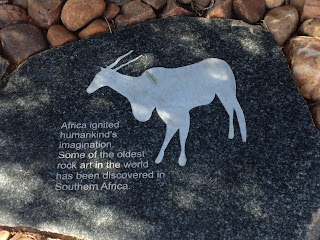
On Sunday, while Dr. Mandel went to the Joburg market, I went to the "Cradle of Mankind" to Mebokeng and the Sterkfontein caves, where I relearned the history of human evolution, saw some of the original fossils found in the area, and learned that "Mrs. Ples" (the most complete skull of an Australopithecus africanus specimen ever found in South Africa - found in the Sterkfontein area) may actually be Mr. Ples.


Is that a goiter?


 The caves at Sterkfontein.

"Little foot" is still being excavated behind these walls
The elephant. Can you make it out - or were we too long underground?